Psyllium Buyer’s Guide
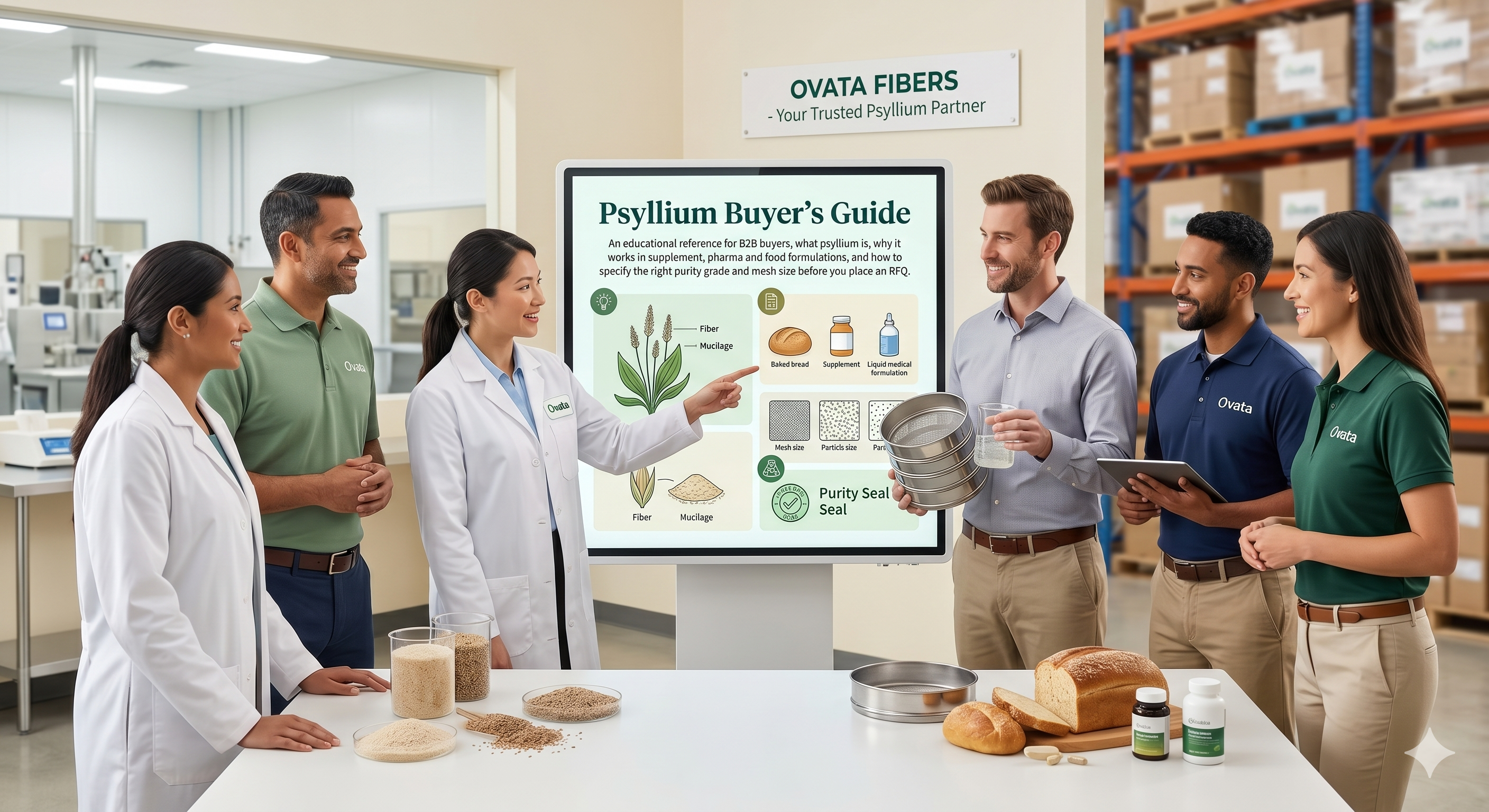
An educational reference for B2B buyers, what psyllium is, why it works in supplement, pharma and food formulations, and how to specify the right purity grade and mesh size before you place an RFQ.
Psyllium & Plantago ovata
Psyllium is the milled outer seed coat of Plantago ovata, a desert-tolerant herbaceous plant cultivated extensively in north-western India. Roughly 80% of the world’s psyllium crop is grown across the Gujarat-Rajasthan belt.
Mucilage Fibre
The seed coat is rich in arabinoxylan mucilage, a soluble dietary fibre that gels with water, giving psyllium its characteristic swell volume and viscosity profile.
Soluble + Insoluble
Approximately 70% soluble and 30% insoluble fibre. The blend supports both stool-bulking and viscosity-driven actions in supplement formulations.
Pharmacopoeial Listing
Recognised in USP, EP, BP and IP. Used in OTC laxative monographs and in clinically-substantiated cholesterol-lowering supplement claims.
Three Forms: Pick the Right One
Each links through to its full specification sheet, packaging options, and application notes.
Psyllium Husk
The milled outer epidermis in flake form. Standard B2B export grade for bulk fibre supplements, gluten-free baking and pharmaceutical laxatives.
Psyllium Husk Powder
Finely milled husk for capsule fill, tablet binding, beverage mixes, and ultra-fine cosmetic emulsions.
Psyllium Seeds
Sortex-cleaned Plantago ovata seeds for in-house milling, ayurvedic formulators, and herbal supplement manufacturing.
85% to 99%: How to Choose
Purity is the percentage of psyllium husk content versus residual seed and foreign matter. Higher purity means higher swell volume and lower particulate variation, but at a cost premium.
85% Industrial / Bulk
Cost-efficient grade for bulk fibre fortification, animal feed, and applications where appearance is less critical than fibre content.
95% Food & Supplement
Standard B2B export grade for dietary fibre powders, gluten-free baking blends, and capsule formulations.
98% Premium Supplement
High-purity grade for branded supplement lines, beverage mixes, and functional foods with stricter visual specs.
99% Pharmaceutical
USP/EP grade with swell volume ≥40 ml/g. For OTC laxative monographs and pharmacopoeial-compliant supplements.
Choosing the Right Mesh Size
Higher mesh number means finer particles. Selection is driven by your downstream process, capsule fillers, tablet presses, beverage solubility, or baking absorption.
| Mesh | Particle Size | Best For | Common In |
|---|---|---|---|
| 40 mesh | ~420 μm | Bulk husk in flake form | Industrial fibre, animal feed |
| 60 mesh | ~250 μm | Capsule fill flow rate | Two-piece HPMC / gelatin capsules |
| 80 mesh | ~180 μm | Capsule + drink mixes | Instant-dissolve beverages, sachets |
| 100 mesh | ~150 μm | Tablet binding | Compressed tablets, dough enrichment |
| 200 mesh | ~75 μm | Ultra-fine, smooth mouthfeel | Orodispersible, beverages, cosmetics |
Why Buyers Formulate With Psyllium
Cholesterol Support
Soluble fibre intake of ~7 g/day from psyllium husk is the basis for the FDA-authorised heart-health claim relating to coronary heart disease risk reduction.
Digestive Regularity
Bulk-forming action, combining stool softening (soluble) with bulking (insoluble). Used in OTC laxative monographs across major pharmacopoeias.
Glycaemic Modulation
Viscous mucilage slows gastric emptying and glucose absorption. Increasingly formulated into GLP-1 companion products and metabolic-health supplements.
Prebiotic Activity
Partial fermentation by colonic microbiota produces short-chain fatty acids, supporting gut-microbiome and prebiotic claim sets.